The 37th KAGRA Face-to-Face meeting
The 37th KAGRA Face-to-Face Meeting was held in Osaka, Japan, from August 26 to 28. A large number of researchers from Japan and Australia gathered for the event and exchanged ideas.

The 37th KAGRA Face-to-Face Meeting was held in Osaka, Japan, from August 26 to 28. A large number of researchers from Japan and Australia gathered for the event and exchanged ideas.
There is a ski resort near Kamioka Town, and the UWA visitors went skiing during the weekends. It was Alex’s first time skiing, but she made rapid progress thanks to Carl, who turned out to be a very good teacher.
They also joined a hiking trip to Kamikochi organized by Okinaka-san, a secretary at ICRR. Kenta Tanaka and Nojiri-san also joined the trip, making it a very enjoyable outdoor activity during the visit.


ASPIRE visitors who come to KAGRA usually stay in a hotel in Kamioka Town. It is a quiet and small town. A local bus runs between the town and the KAGRA control room, and the trip takes about 40 minutes. The supermarket is located near the hotel, making it convenient for daily shopping.
Kamioka is surrounded by beautiful mountains and rivers, offering a peaceful environment for both research and relaxation. The town is also known for hosting major underground physics experiments such as Super-Kamiokande and KAGRA.


There are also many restaurants and izakaya (Japanese-style pubs) in the town. However, most staff do not speak English and menus are usually available only in Japanese. Fortunately, translation tools such as ChatGPT can be very helpful for understanding the menu.
Jian Liu, a postdoctoral researcher, and Emily Mazalevskis, a master student from UWA, visited Science Tokyo and worked with Suzuki Kaido on the optical spring experiment for two weeks.
During their visit, they also traveled to the KAGRA, where they met with Carl Blair and Alexandra Adam. In addition, they visited NAOJ to discuss ongoing work on the filter cavity experiment and birefringence experiment.

Dr. Carl Blair from the University of Western Australia (UWA) is visiting the KAGRA Observatory for one month. This year he is accompanied by Alexandra Adam, a PhD student at UWA. During their stay, they are collaborating with the KAGRA team on research focused on reducing beam jitter noise, contributing to ongoing efforts to improve the performance of the gravitational-wave detector.

This year, four participants from Japan, including Kentaro, attended the OzGrav Retreat. We hope that more students from Japan will participate next year. During the poster session, Kentaro presented an introduction to the ASPIRE GW projects, and participants were invited to register in order to receive a free sticker.

Ryo, Yusuke and Haoyu participated in the OzGrav ECR Workshop in Melbourne shortly before the Retreat. The workshop provided a friendly forum for early career researchers to communicate and exchange ideas, alongside career development activities such as mentoring sessions, panel discussions, and introductory talks on commonly used tools in the gravitational-wave community. A special session allowed participants to freely meet and ask questions directly to the Chief Investigators, and the program concluded with a social evening featuring bowling, laser tag, and arcade games.


Ruizhe Wan, a research student at Science Tokyo working in Kentaro’s group, had the opportunity to visit UWA for two weeks. During this visit, he participated in experiments on the measurement of thermally induced birefringence together with Carl and Haoyu.
After a one-month stay in Prof. Linqing Wen’s group at UWA, Diego is visiting ANU again. This time, he will spend another month at ANU working with Sun Ling (Lilly) on a long-term project.

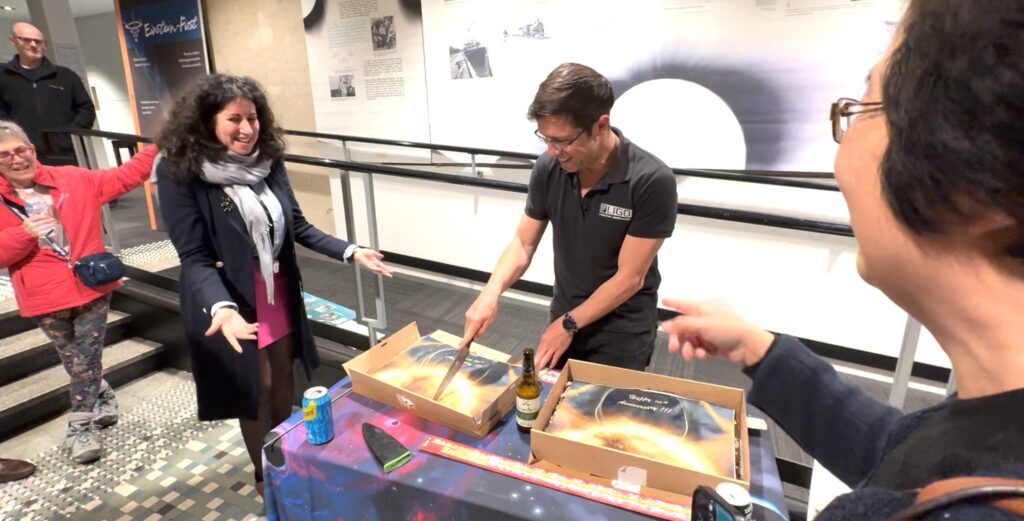
The UWA group celebrated the 10-year anniversary of the discovery of gravitational waves with a vibrant event. Professors, postdocs, and students gave short talks highlighting how their research connects to the broader field of gravitational-wave science, underscoring the lasting impact of this milestone discovery.
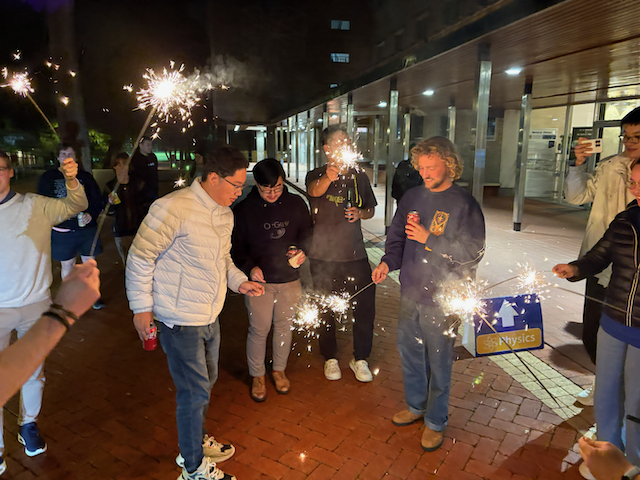
The academic program was followed by a lively celebration with pizza, drinks, cakes, and fireworks, bringing everyone together in a festive atmosphere. Haoyu was delighted to join this memorable occasion during his stay in Perth.